- Minds x Machines
- Posts
- How I Scored a 3/10 and Still Won at AI
How I Scored a 3/10 and Still Won at AI
Everyone has access to the same tools; not everyone has standards

Tanye ver Loren van Themaat
December 05, 2025


Turning AI into leverage
The Setup Matters More Than the Tool
Most people treat AI like a microwave: throw raw ingredients in, press a button, and expect a Michelin-star meal.
And then they are annoyed if AI gives them output that sounds like the statistical average of the internet. Beige. Generic. Indistinguishable. Content so neutral it could negotiate a peace treaty.
When you yell vague instructions at AI, AI enthusiastically obliges, producing something professional-ish that could have been written by that could have been written by any middle manager in 2004.
Vague in, vague out. The universe remains fair.
It's technically correct but strategically useless. It’s WORKSLOP.
The fundamental problem is that AI doesn't know what you want unless you teach it. And teaching AI isn't about finding the perfect prompt. It's about doing the hard work of defining your standards before you ever open ChatGPT.
This is the story a brutal 3/10 score taught me of the value of setup.
The "Brand Guardian" Story
I recently ran an AI assistant-building workshop (part of our CRAWL phase) with a client. The mission was to build a Brand Guardian, n AI assistant that reviews communications and ensures everything aligns with the company brand.
My client had spent years refining two massive documents: their House Editorial Guide and Brand Philosophy.

Impressive work. Detailed. Specific. The kind of documentation most organisations never bother to create.
Once everyone built their Brand Guardian (yes, they all had to build it themselves), we started testing.
The AI assistant was designed to give us specific output:
A structured critique with a score out of 10, a vibe check, and a detailed table citing specific rule violations.
I ran my own writing through it.
Score: 3/10.
My first reaction: How dare it? The betrayal. Not the performance review I was expecting today.

Why 3/10 Proves Success
The system wasn't broken. It was working perfectly.
Annoying habit, doing exactly what we built it to do.

The client's brand is authoritative, precise, and serious. My brand is edgy, fun, and provocative. Different standards, different scores.

The Brand Guardian AI wasn't evaluating whether the writing was "good" in some universal sense. It was measuring alignment with their specific standards.
This distinction matters more than most people realise.

Writing is not a single discipline with universal rules. It is a multiverse of interconnected but distinct styles, each with its own conventions, constraints, rhythms, and measures of success.
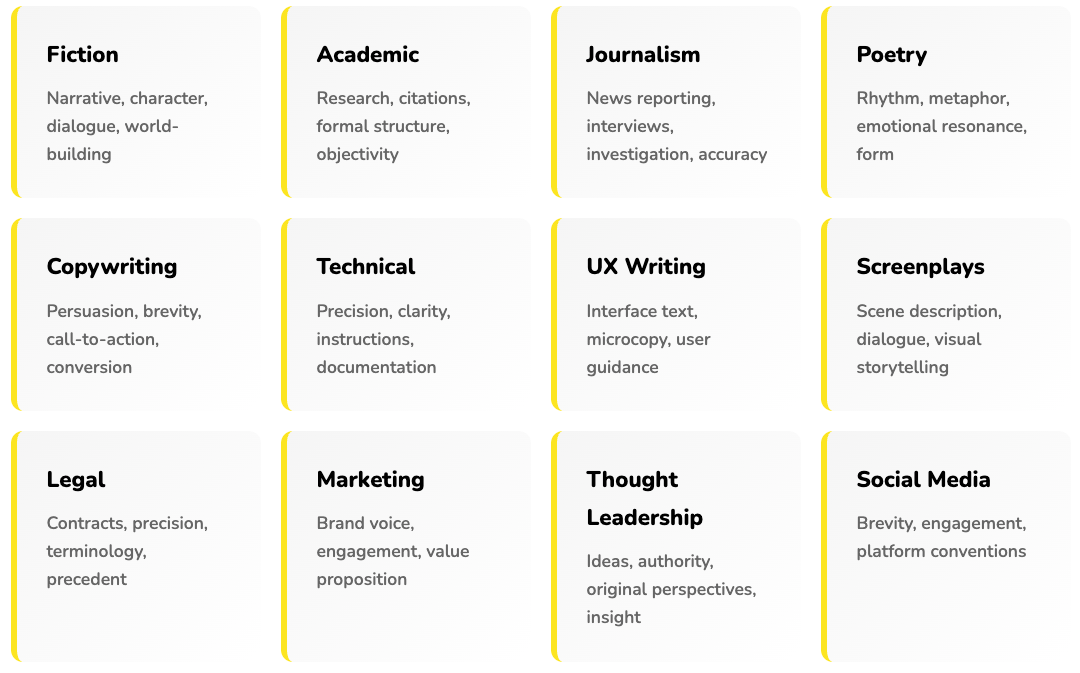
Layer in different industries, brands, contexts, audiences — and "good writing" becomes a question of good for what?

Writing only becomes good once you decide what you’re optimising for.
Even grammar isn't fixed. Should you use the Oxford comma? Is it "e-mail" or "email"? Do you write "10" or "ten"? These aren't right or wrong. They're decisions.
These aren't right or wrong. They're decisions.
The competitive advantage isn't knowing the rules. It's knowing your rules and encoding them so AI can enforce them at scale.
What My Client Did That Worked
The magic didn't just come from the AI. It came from the preparation.
First: They had documented their standards.
Not vague aspirations. Explicit guidelines. If they hadn't done this hard work, the AI would have hallucinated a personality for them. Probably something between a corporate motivational poster and a motivational speaker who’s had too much coffee.
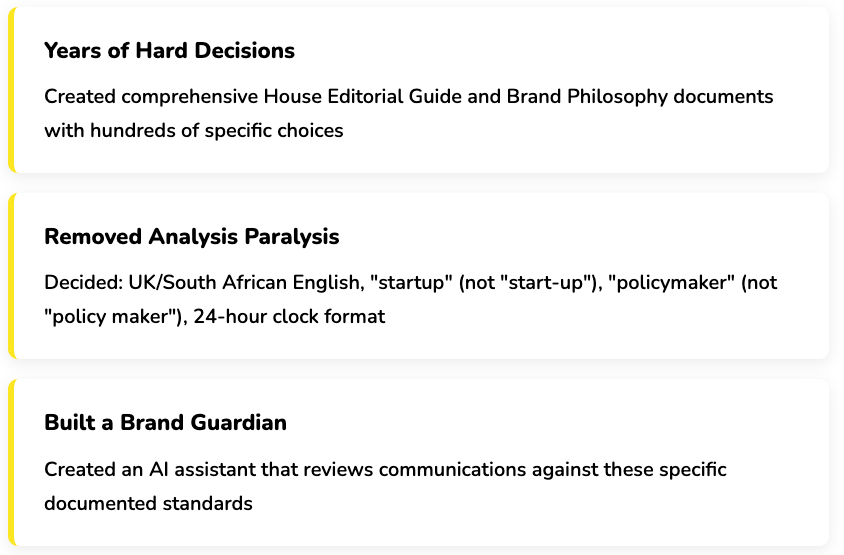
Second: They operationalised those documents as AI instructions.
This isn't digitising content. It's converting human-readable guidelines into machine-executable parameters. Guidelines that can be applied consistently, instantly, and at scale.
The outcome: In our two-hour session, every participant built a functional, immediately usable assistant.
The Tacit Knowledge Challenge
The hardest part of the setup is that most experts don't know how they do what they do. This is called Tacit Knowledge. You think you just "know" how to write a good report, but you are actually running a complex, subconscious algorithm.
When someone asks, "How do you write so well?" you might say, "I don't know, it just flows." But that's not helpful for teaching someone else, and it's certainly not helpful for teaching AI.
Examples of Tacit Knowledge
Writing: You instinctively vary sentence length for rhythm, but you've never articulated this rule
Design: You know when spacing "feels wrong," but can't explain the exact pixel count
Analysis: You spot patterns in data quickly, but don't consciously know your scanning process
Communication: You adjust tone based on context, but haven't codified when and how
You cannot "AI-ify" a feeling. You have to turn that feeling into a Rule Set, extracting your tacit knowledge and codifying it into explicit systems.
Before and After
Before AI : Passive Documents
Junior team member writes something. Manager reviews manually. Someone digs up the style guide (or tries to remember it). Feedback is subjective. Consistency depends on who's reviewing that day.
Worse still: the brand guide quietly weeps in a forgotten SharePoint folder.
After AI: Active Data
Anyone writes something. The Brand Guardian reviews instantly: score, vibe check, rule violations. The writer aligns their draft. The manager focuses on strategy, not compliance.
At last, something in the organisation that reads the documentation.
Same standards apply whether it's the intern or the CEO. Finally, even the CEO gets feedback!
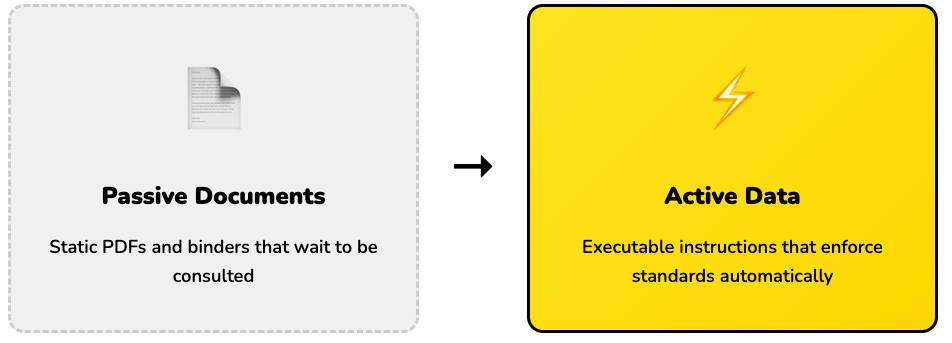
This is the power of AI.

One Setup, Infinite Scale
Creating this foundation, the documented standards, the explicit workflows , is hard work. It requires introspection and discipline. Most organisations balk at the investment.
But the payoff is massive and permanent:

When AI knows your standards, it becomes predictable. When it's predictable, it becomes trustworthy. When it's trustworthy, it becomes useful.
Everyone has access to the same AI tools. ChatGPT, Claude, Gemini, your competitors have them too. The competitive advantage isn't the technology. It's your craftsmanship in setting it up.
The advantage isn’t AI. It’s the person who bothered to think.
The companies that win aren't the ones with the fanciest prompts. They're the ones who've done the work: understanding their processes, documenting their standards, turning tacit knowledge into explicit systems.

Excellence must come first. Before you can create effective alignment rules, you need absolute clarity about what constitutes good writing for your specific needs.
From standards to rules. Once you understand what excellence means, you can begin translating those standards into explicit rules.
Designing AI around your standards. A properly designed AI system acts as a guardian of your defined quality standards.
Infrastructure work. Sexy? No. Strategic? Completely.
Less glamorous than generating Cats in space suits. But infrastructure is what separates functioning organisations from chaotic ones.
The Path Forward: From Crawl to Fly
Most organisations are treating AI as new software. It is a completely new way of working.
That is why Thundamental developed the Crawl, Walk, Run, Fly Framework.
It is a simple and progressive approach to implementing AI into your organisation, starting with AI Literacy and Governance.

We start with AI training, to get your team to identify opportunities in their own workflows.
👉 Contact us for a strategy call to start your AI journey.

Let’s AI-ify your organisation?
Start with Ai Education, and work your way up to AI systems… start simple.
👉 Contact us and let’s get started.
If you forget everything else, remember this…
The limiting factor in AI isn’t AI.
Don’t want to miss our next newsletter? | Or, if you’re already a subscriber… |