- Minds x Machines
- Posts
- You’ve Been Workslopped: A Corporate Survival Guide
You’ve Been Workslopped: A Corporate Survival Guide
And Avoiding the Reputational Damage of a Workslop

Tanye ver Loren van Themaat
October 17, 2025


Turning AI into leverage
The Problem Has a Name
Derek from marketing sends a "comprehensive marketing strategy."
47 slides. Beautiful formatting. Charts that belong in MoMA.

Cody's rewriting it. Luiza's fixing the competitor that both launched in 2035 AND is simultaneously a startup and Fortune 500 company. Jenkins went to lunch. Zee (CEO) gave up and started from scratch.
Four different people are now doing the work Derek thought he'd finished.
Derek has invented something remarkable: a document that creates more work than if he'd done nothing at all. It's the corporate equivalent of a perpetual motion machine, except instead of free energy, it generates free irritation.
The colleagues feel confused, irritated, frustrated, lost…

Understanding Workslop
Research from BetterUp Labs and Stanford Social Media Lab describes workslop as:
“AI-generated work content that masquerades as good work but lacks the substance to meaningfully advance a given task.”
The study further elaborates:

Workslop isn't just poor-quality content, it's content that actively wastes time and creates confusion, offence and annoyance. You know it, right?
It's the AI-generated report that looks professional but contains no real insight. It's the comprehensive email that says nothing actionable. It's the presentation deck that uses all the right buzzwords but provides no clarity.
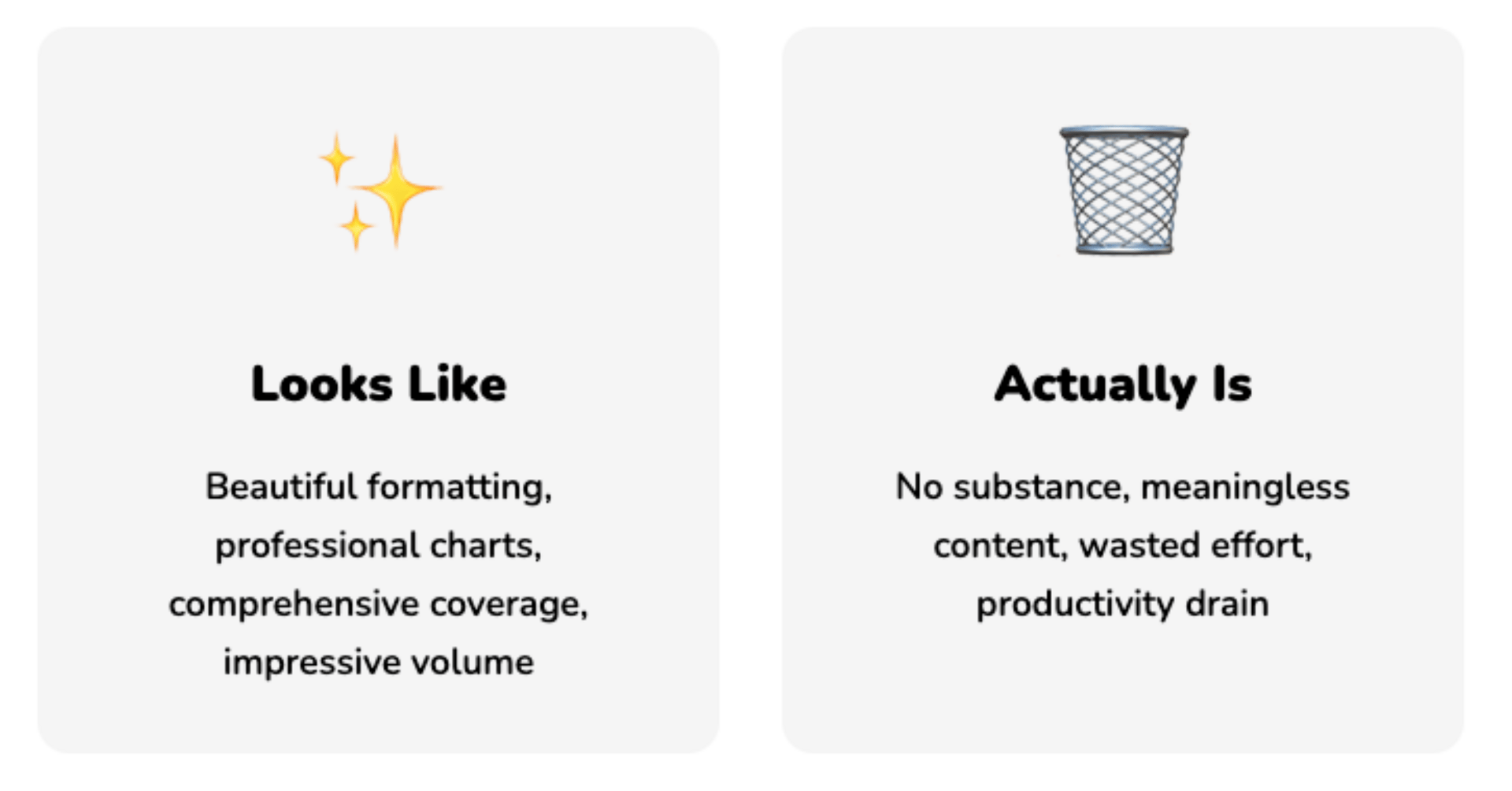
The defining characteristic of workslop is that it transfers cognitive burden from creator to recipient. Instead of the creator doing the hard work of thinking, analysing, and synthesising information, they outsource this burden to everyone who receives the content.

Why Now? The Asymmetry Problem
In traditional work, there was a natural limit to how much low-quality content someone could produce: creating content and output required effort.
Poor quality work was obvious.
AI removes this constraint. Now one person can generate dozens of reports, emails, and decks in the time one careful document once took. Creation is 10x faster, but comprehension is not because reading and acting still take as long.
This creates a dangerous asymmetry: Creation is now 10x faster, but comprehension hasn't changed. It still takes the same amount of time to read, understand, and act on information.
When organisations don't account for this asymmetry, they drown in content whilst starving for insight.
We've achieved the impossible: productivity so efficient it goes backwards… like inventing a car that makes walking faster.
When low-quality work becomes acceptable, high performers become frustrated. When comprehensive means long rather than thorough, critical thinking atrophies. When volume matters more than value, the organisation optimises for the wrong metrics entirely.
Workslop isn't just annoying. It's expensive. Here's what it actually costs:
1) Time & Money
Each instance of workslop costs an average of 1 hour and 56 minutes (study) of rework. When Derek sends workslop to a team of four, that's 6.5 hours of lost productivity from a single thoughtless AI copy-paste.

±1h56min wasted per workslop incident
We've invented negative productivity.
2) Reputation Erosion:
You send workslop. People stop wanting to work with you. Not immediately, of course.
First, they add you to the list: "Colleagues whose emails require three coffees and an emotional support animal."
Later, they start complaining about you and you are seen as:

I have experienced this and I stop trusting any work from the person who workslopped me. And it is a workslap in the face ;-)
As Luiza candidly noted:
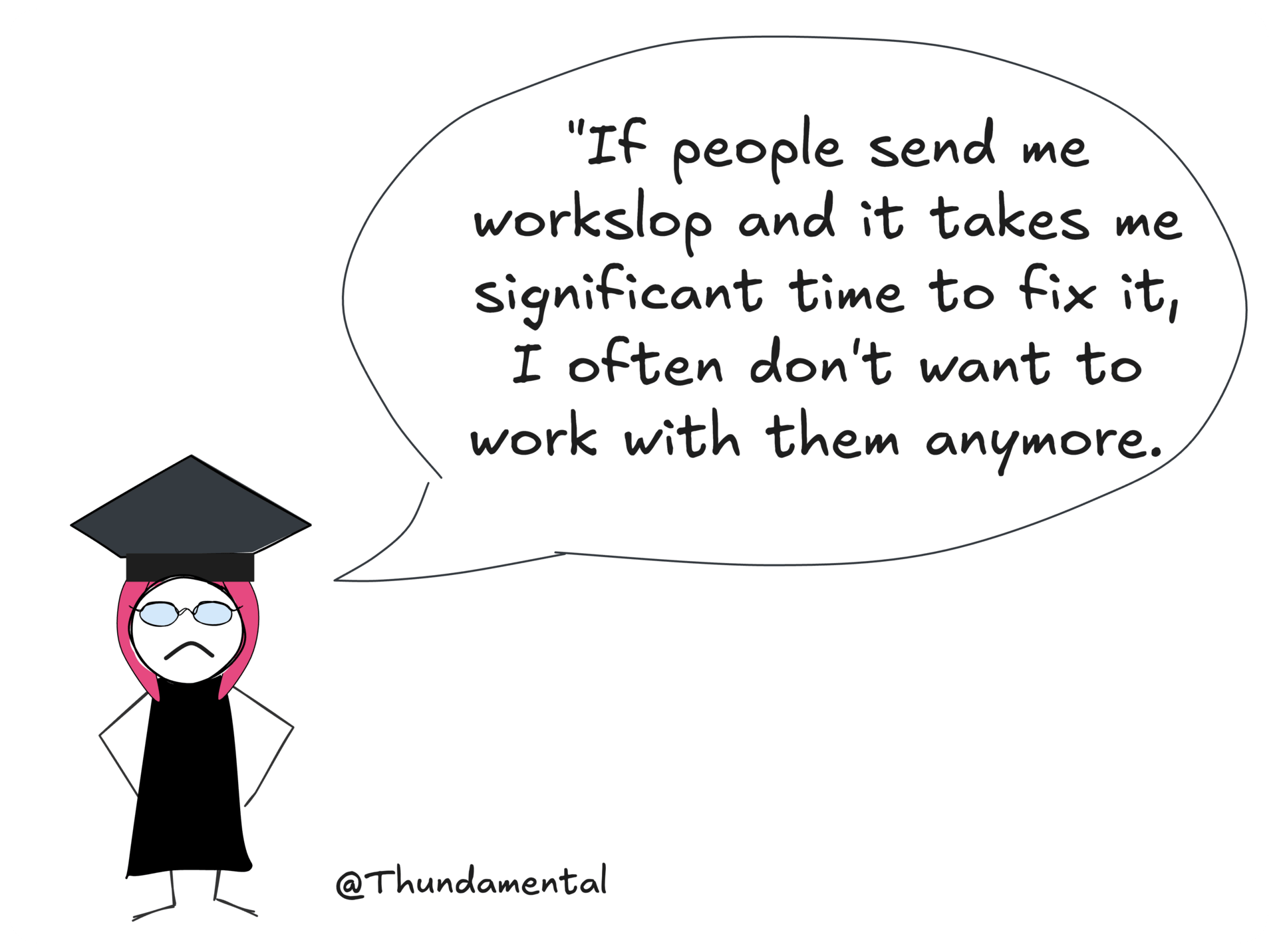
Luiza will eventually realize she can get better results by cutting out the middleman and talking directly to ChatGPT. She will at least read the output - already better than Derek’s work.
3) Career Risk
If your job consists of pressing "generate" and "send," congrats: you've made yourself optional. If you can be replaced by a better prompt, why do they need you?
This Isn't Just a Junior Problem
Workslop is happening at every level:
40% from peers to peers
18% from direct reports to managers
16% from managers to teams
26% from cross-functional teams and external partners
Self-Diagnosis: Are You the Problem?
Think nobody noticed your AI shortcuts? They noticed. They're just too polite to say you've become the human equivalent of a "Reply All" email.

If you send workslop you declare that “This represents my thinking”!
If you can’t check any of these boxes, don’t send it.
Else you are replaceable… like Derek.

What would your boss say if she saw your prompts?
The Anti-Workslop Framework
I have an Anti-Slop policy in my company. No workslop allowed. I send it back immediately.
And I am helping my clients develop their own Anti-Slop Frameworks and culture, when we build the AI usage policies. It is one of the guardrails in the sandbox.

But it requires a fundamental mindset shift.
Using AI Poorly Will Cost You:
Your professional reputation: People see you as less competent, less creative, lazy, and less trustworthy when they detect AI-generated work
Your team's productivity: Each workslop incident creates nearly 2 hours of rework for someone else
Your job security: If a better prompt can do your job, why do they need you?
Using AI Well Will Give You:
More time for strategic work: By automating the right tasks, you free yourself for work that truly matters
Significantly better outputs: AI as a thought partner produces superior results to AI as a replacement
Competitive advantage: The gap between AI users widens daily; excellence compounds while mediocrity stagnates
The goal: Reach a point where your AI usage is so sophisticated that others can't detect it, not because you're hiding it, but because the final output is indistinguishable from your best human-only work. it should be better, because AI has helped you think more deeply, consider more angles, and refine your ideas more thoroughly.

Passenger or Pilot: Which are You?
Research shows that workers with high agency and high optimism (Pilots) dramatically outperform those with low agency and low optimism (Passengers). This isn't just about attitude, it's about fundamental approach to AI usage.
Your relationship with AI determines your outcomes. Are you steering, or just along for the ride?
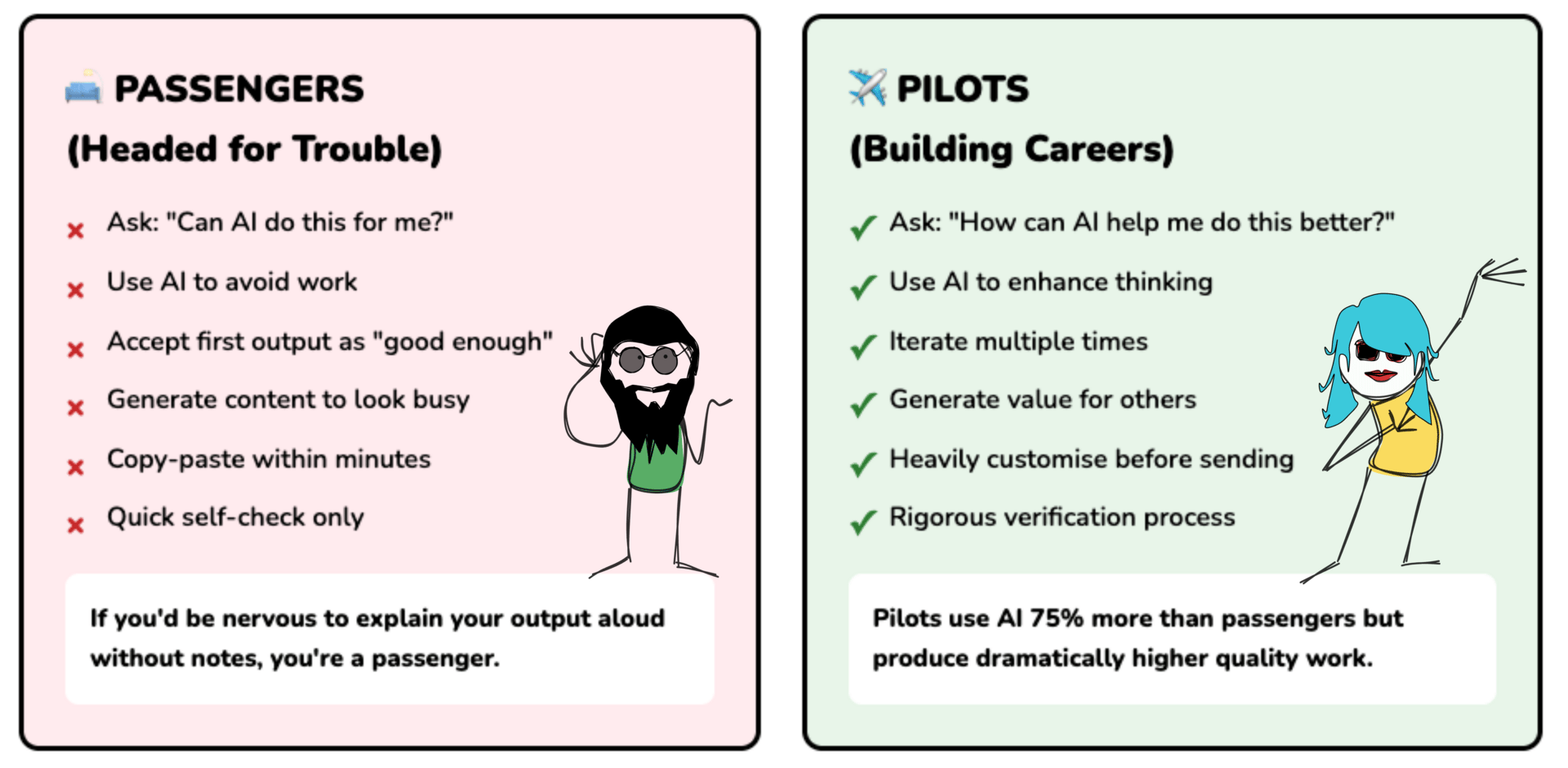
Pilots have Three Core Attitudes
1. High Agency: "I'm in control"
Pilots view AI as a tool they control, not a replacement for their thinking. When something goes wrong, they recognise they failed to provide the right direction or verification.
High agency means asking: "How can I direct AI to help me achieve this outcome?" rather than "Can AI do this for me?"
2. High Optimism: "AI can help me do extraordinary work"
Pilots believe AI can elevate their work to previously unattainable levels. Crucially, this isn't blind optimism, pilots understand AI's limitations intimately because they've tested those boundaries.
3. Purpose-Driven Usage: "I use AI for specific outcomes"
Pilots identify specific tasks where AI provides genuine value: brainstorming alternatives, reformatting information, checking logic, or synthesising insights.
Before touching AI, pilots ask: "What specific outcome am I trying to achieve, and is AI the right tool for this job?" This selectivity separates pilots from passengers who reach for AI reflexively.
The Four Quality Gates
Pilots use this safety net. The Four Gates aren’t just a checklist, they are a MINDSET SHIFT:
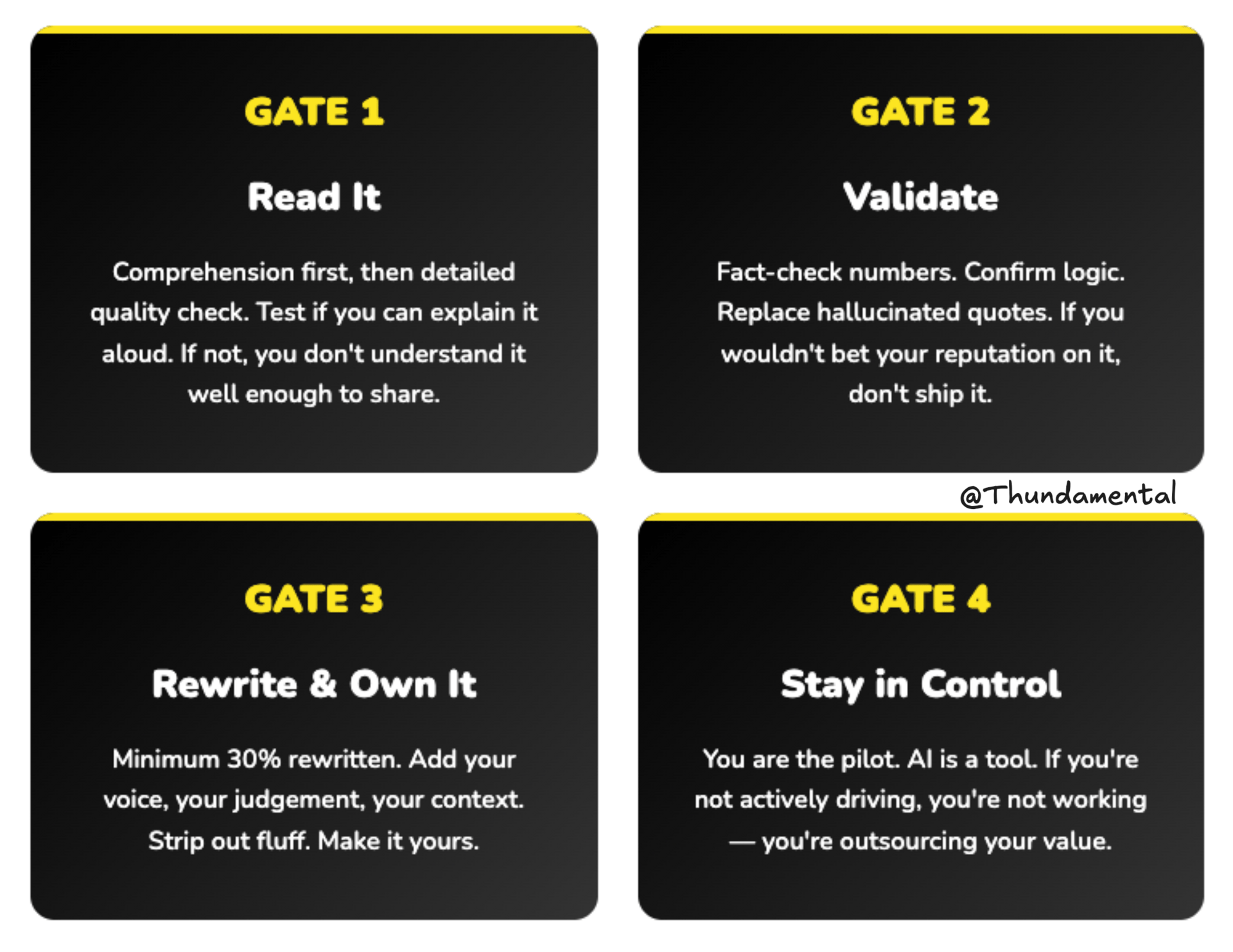
The transition from passenger to pilot isn't about using AI more, it's about using it better.
Pilots often spend more time with AI, but that time is invested in iteration, refinement, and verification. They generate more outputs, but send fewer.
That is why I start with AI Fluency in organisations. To develop the Pilots.
You don’t want to be the person known for workslop.
In the AI age, credibility is not about speed. It’s about stewardship. Your reputation travels with your outputs.
AI literacy isn’t about how well you prompt. It’s about how well you refine what AI gives you.
Own It or Don’t Send It
We’re at a decision point.
We can use AI to press buttons faster.
Or we can use it to make our thinking sharper.
We can cut corners. Or raise the bar.

Let us help you build an AI-enabled Organisation?
We start with AI Fluency, and then move to implementing more sophisticated Ai systems.
Start Simple. Prove Value. Scale what works.

👉 Schedule a free consultation and let’s get started.
If you forget everything else, remember this…
"Develop AI Builders Internally"
Don’t want to miss our next newsletter? | Or, if you’re already a subscriber… |