- Minds x Machines
- Posts
- The Anti-To-Do List
The Anti-To-Do List
Why AI Should Start With the Work That Doesn’t Require You

Tanye ver Loren van Themaat
April 23, 2026

Turning AI into leverage
I have a task I avoid.
When a new client signs up, I need to upload them to my learner management system, set up their access, send the welcome sequence. It takes about thirty minutes. It's not hard. It's not complicated. It's just... boring.
There's no thinking involved. No judgement, no creativity, no decision that benefits from my experience. It's just a lot of copying and pasting from one system to another.

Everyone has one of these. Maybe yours is manually deleting spam from a shared inbox. Categorising expenses. Capturing invoices. Reformatting the same spreadsheet every month because someone upstream can't stick to a template.
I started doing an Anti To-Do List.
It treats recurring tasks as bugs, not features. If something shows up on your list more than twice, the real question is not "how do I do this faster?" It is "how do I stop doing this at all?"

Every task on it still matters. It's not about what to drop; it's about figuring out what can be automated away. And instead of tolerating the tasks like some kind of professional martyrdom, I dedicate time to systematically killing them off.
Why this matters now
Two years ago, the cost of automating an annoying task was a two-week engineering project. Today it can be a fifteen-minute conversation with an AI, a saved Gem, or a Skill.
The economics flipped. Most people have not updated their habits to match.
The boredom is the tax, not the task.
The real killer isn't just the time. It's the mental load.
When you look at a boring recurring task, you probably tell yourself a familiar story: "It's only thirty minutes. I'll just get it done." That story is a trap.
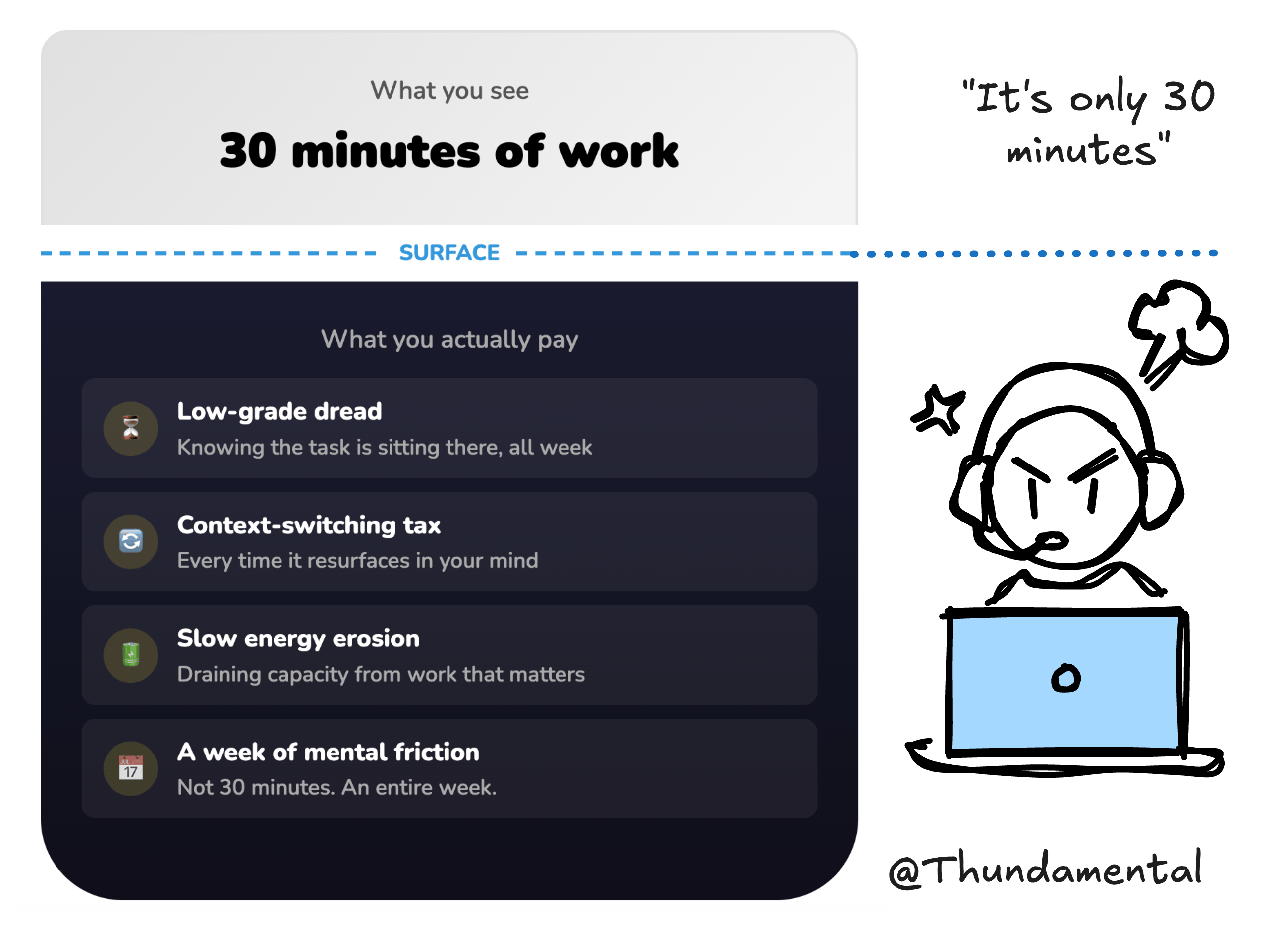
The real damage of these tedious, non-thinking tasks is the low-grade dread of knowing it's sitting there. The context-switching tax every time it resurfaces. The slow erosion of energy.
You're not paying for thirty minutes of work. You're paying for a week of mental friction.

The Diagnostic
Stop managing the workload. Start mapping the breakdown.
Your standard to-do list celebrates completion but ignores recurrence. You tick off "write status report" on Monday and the same task returns on Tuesday. The list is a treadmill disguised as progress.
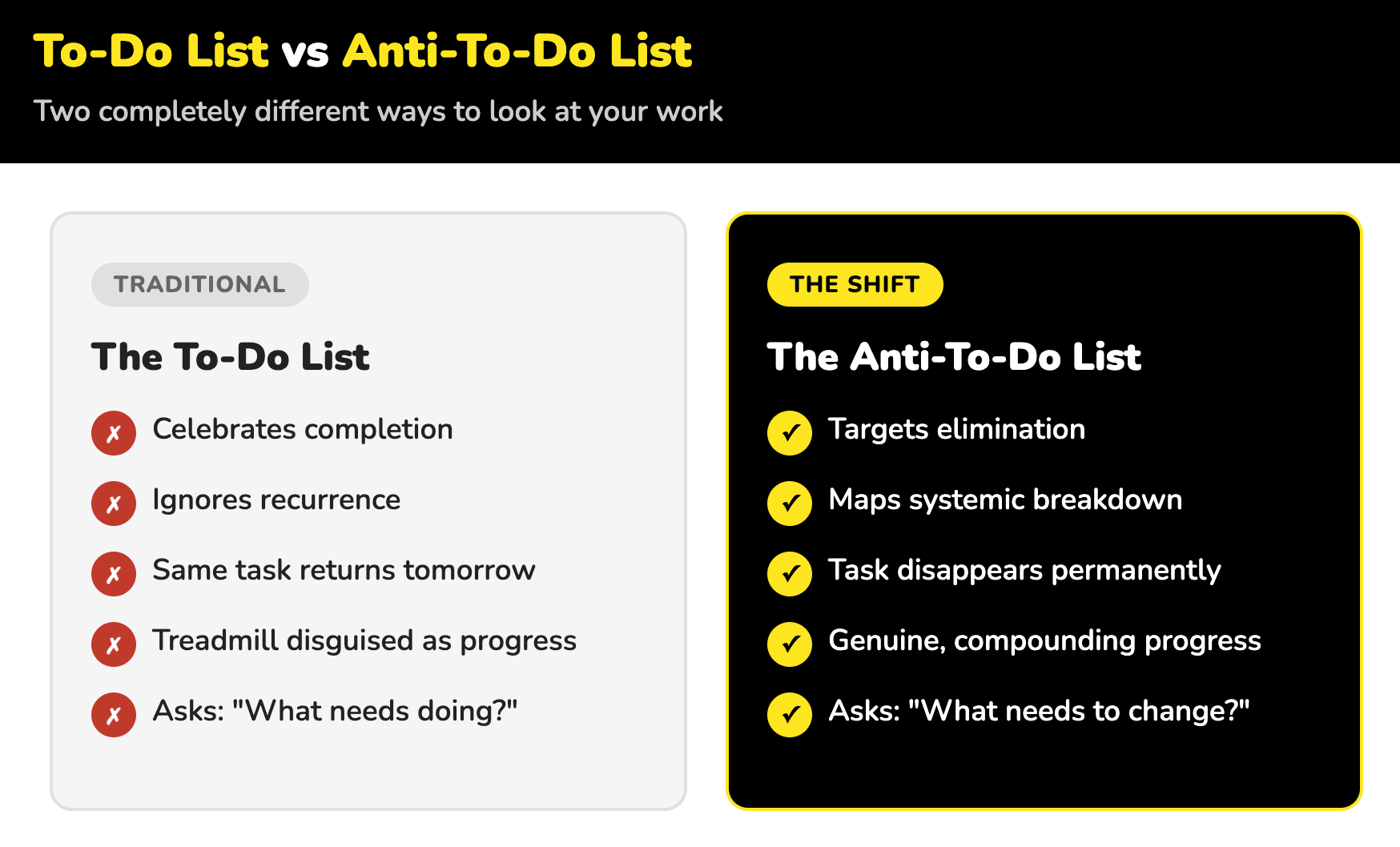
The anti-to-do list flips the frame. It's a record of what needs to change, not what needs to be done. Every repeated manual task is a clue, and the clues usually point to one of three things:
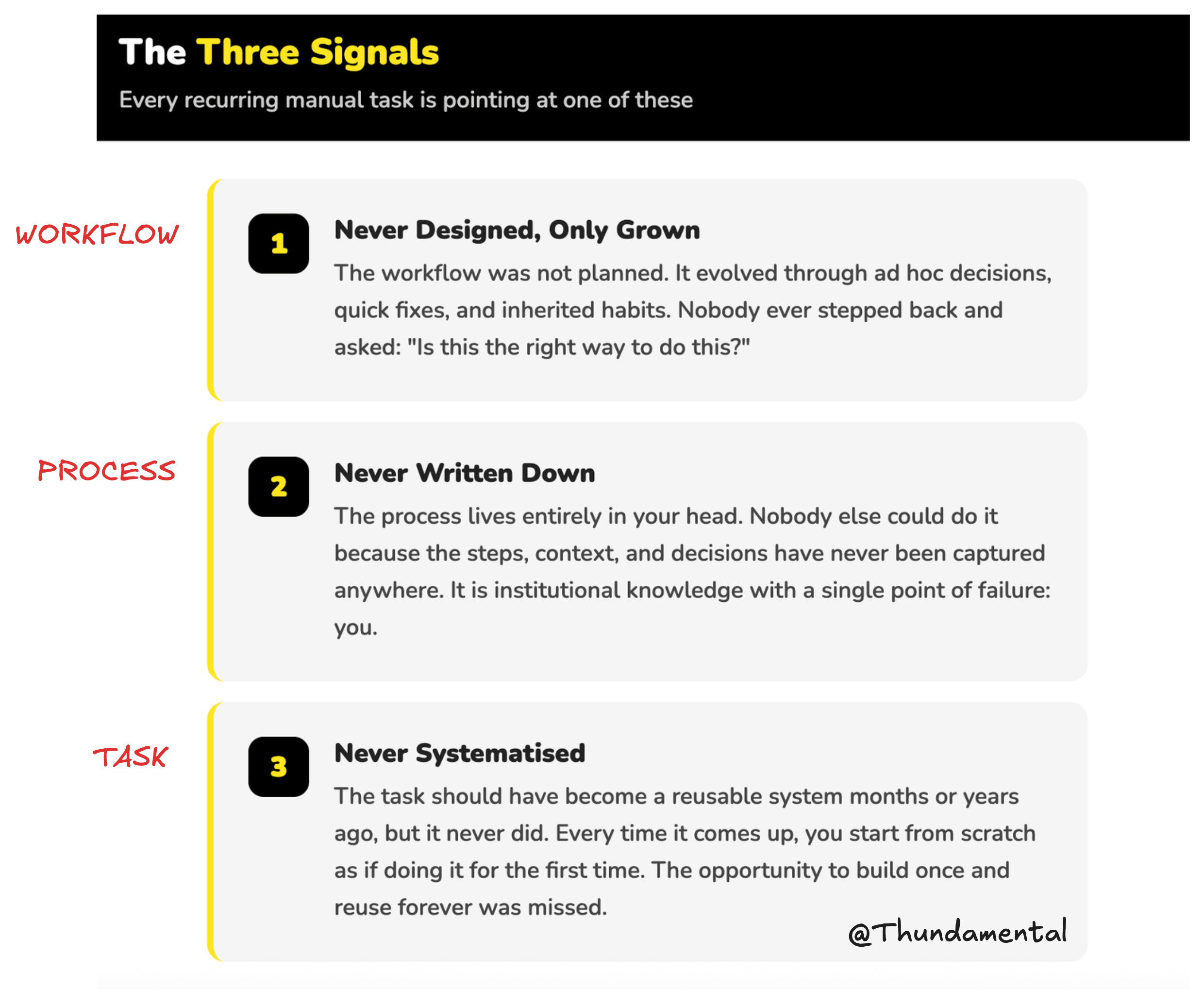
Once you stop treating these tasks as random annoyances and start treating them as signals, you're no longer just managing your workload. You're mapping where your way of working is breaking down.
The Question
Judgement stays. Mechanics go.
Before you can automate anything, you need a filter that's honest. The one I use has exactly three words in it: judgement, taste, or trust.

On one side sits everything where your experience, relationships, or creative point of view are the value. Strategic decisions. Client relationships. Editorial calls. The stuff you were actually hired to do. On the other side sits everything that is mostly mechanics. The stuff that feels like work but isn't really thinking.
When you run the filter properly, you discover that a significant share of what lives on your to-do list isn't actually work that needs you. It just happens to have your name on it. That's not a personal failing. It's a systems problem dressed up as a personal one.
The AI Noise
Cutting through the braai talk
Six months ago, almost nobody knew anyone who actually used AI. Not properly. Now it's the conversation at every braai. Someone's cousin's colleague's wife's sister built something incredible with three keystrokes and one prompt. Changed their whole business, apparently.
Against that noise, the three lies persist.

TRUTH: you will need to set it up. AI can help you. AI can format. But you need to teach it your way of work.
When you're hearing the hype from every direction and your reality is still copy-paste-click-repeat, it can feel overwhelming. Things are not going to settle down.
The only sensible play is to pick one item off the anti-to-do list and build the system to kill it. Then do it again. Then again.
The Meta-Move
Do not just do the work. Make the work disappear for next time.
Every time you complete a task, capture it as a process. Build the system as you do the work. Use Ai to build your Ai systems.
I’m building my super system one small task at a time. It is starting to compound.
I love Claude Skills and Projects and often they start as a task I was doing manually, repeatedly, and getting irritated by. So I captured it (Using AI). Turned the process into a reusable system (Using AI). Now when the task comes up again, the system does the heavy lifting and I do the thinking.
I am backing AI into my work, it isn’t just a cherry on top.

The compounding is the point. A month from now, three things you hate are gone. Three months from now, ten. A year from now, the list looks unrecognisable.

When you capture a workflow and turn it into a reusable system, you create something that belongs to you. Not to a specific tool, not to a specific AI model, and not to a specific platform.
If your "AI strategy" depends on a specific tool’s quirks and copying and pasting, you are building on sand. But if you captured the process and the flow, the underlying logic, the documented steps, the captured decisions, then you can port that system to any tool.
This is the difference between being a user of technology and being someone who has built systems on top of technology. Users are at the mercy of updates, pricing changes, and platform shifts.
System builders are resilient because they own the intellectual architecture of how their work gets done.
Each skill, template, or workflow you build is an investment.

Want to explore how this could work in your organisation?
The question is: Are you ready to learn how to reimagine your business with AI baked in?
👉 Schedule a free consultation and let’s get started.
If you forget everything else, remember this…
"System builders are resilient because they own the intellectual architecture of how their work gets done.
Don’t want to miss our next newsletter? | Or, if you’re already a subscriber… |