- Minds x Machines
- Posts
- I built the same business twice.
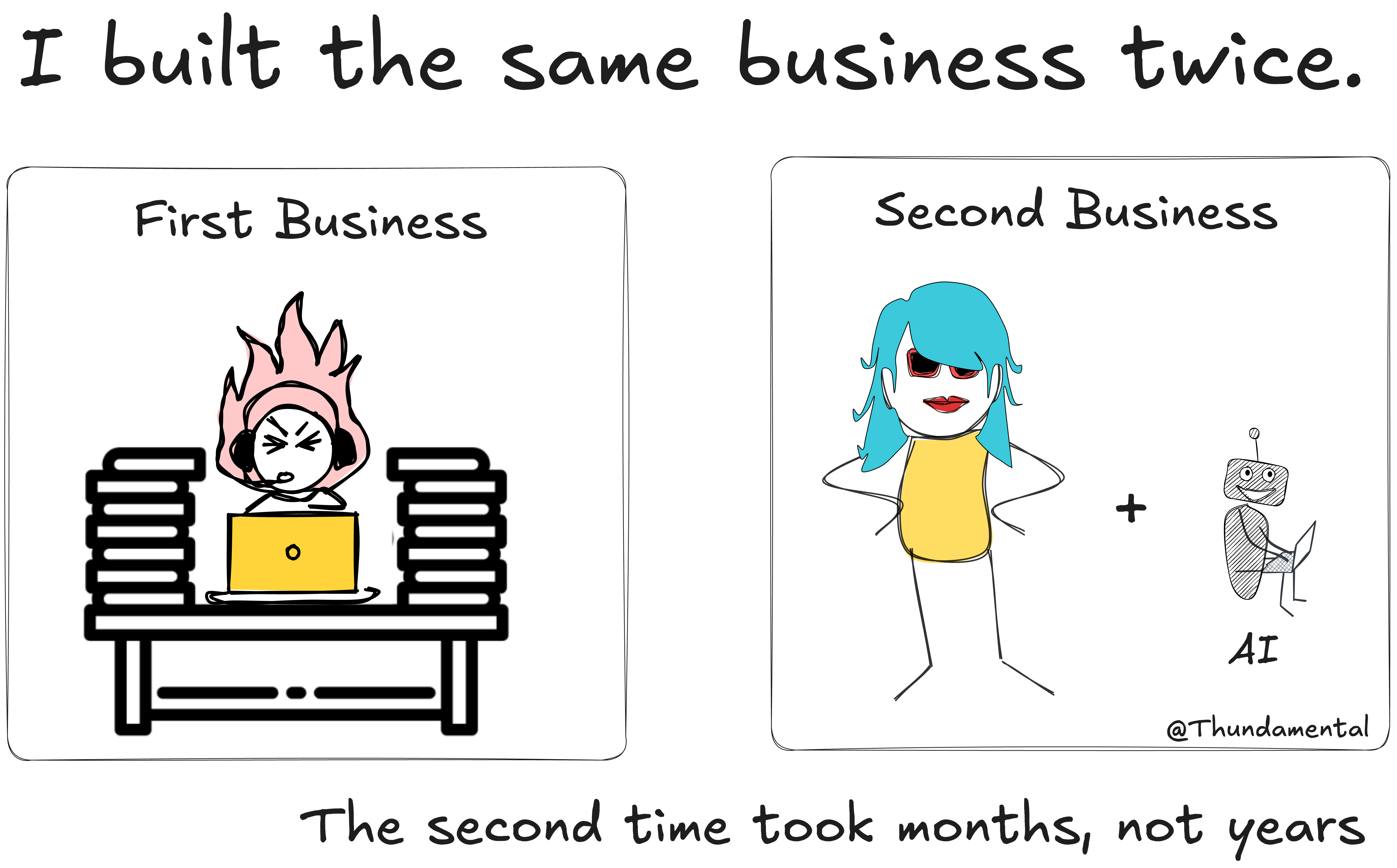
I built the same business twice.
The second time took months, not years. the second time was AI.

Tanye ver Loren van Themaat
March 19, 2026


Turning AI into leverage
The First Business was hard. The Second Business was AI. It was hard in a different way
I've always been a researcher and teacher at heart. Collect dots, connect dots, and help people apply it to their business. That's the job. That's always been the job.
My first business was helping early-stage startups develop their business models.
That meant helping them figure out whether their business should actually exist. In 99.9% of cases, the answer was no, it shouldn't 😬.
My job was to help them pivot and rebuild into something sustainable. But getting people through that process required a full startup programme, built from scratch. Designing frameworks and methodologies, writing every word of content, building slides, creating templates, figuring out how to visually explain difficult concepts so that entrepreneurs could actually test their assumptions.

Customisation was impossible. You had to decide on a direction and stick to it, because if you wanted to change something, you had to go change it everywhere. Manually. Word by word. Slide by slide. The economics were brutal. The cost of creating that quality of content was far more than could ever be charged for it.
Then, early 2024, I realised my business was going to get disrupted. AI could do what I always did. I started learning, exploring, building, started running little workshops.
I Told Myself I'd Never Build a Training Business Again. AI called my bluff
And even after swearing never to run a training business again, the pull was too strong. Collecting dots, connecting dots, simplifying . It's how I'm wired. I just can't stop.
The difference was that this time, AI changed everything about how to build.
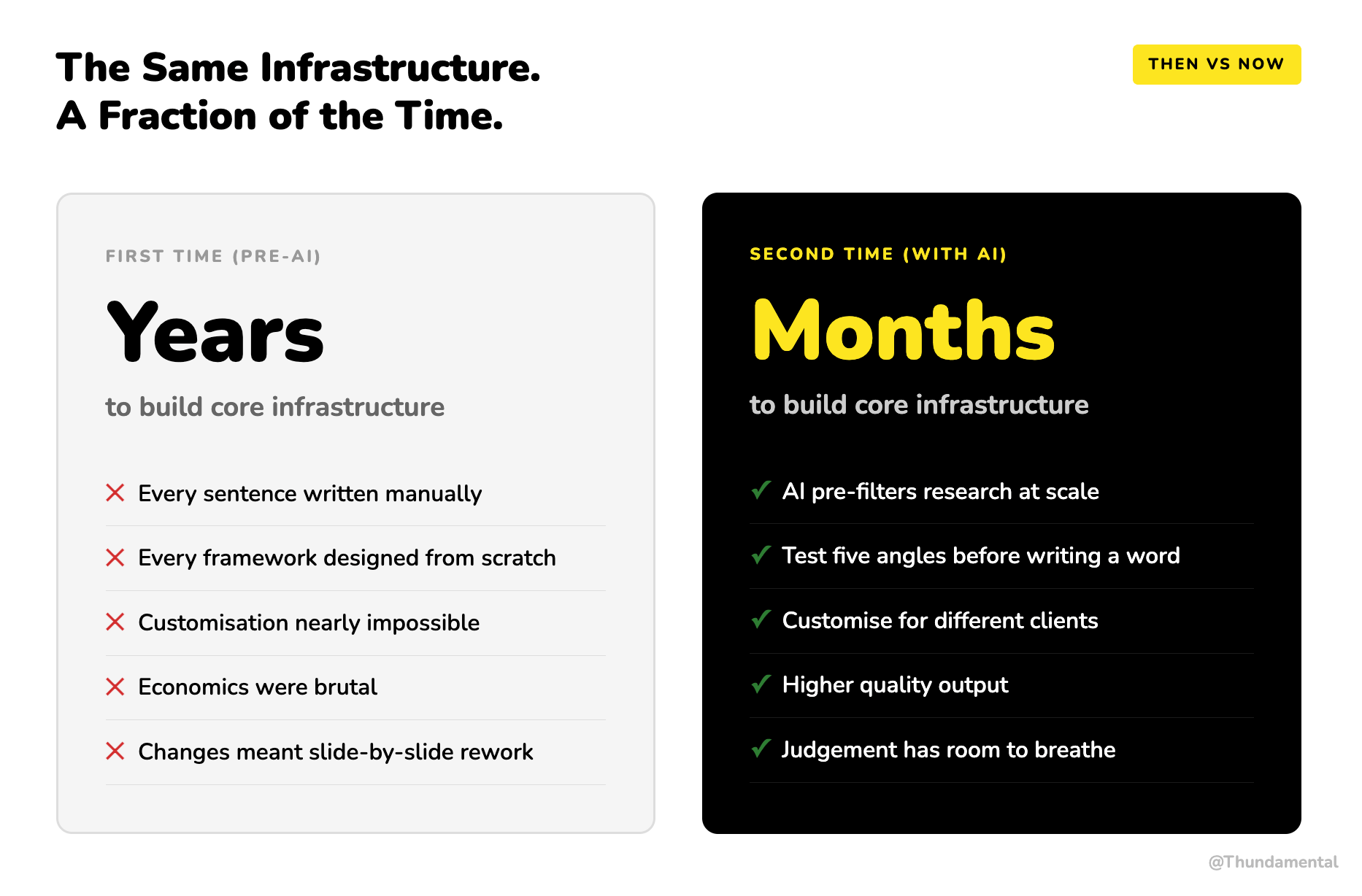
Months were enough to create the same core infrastructure, not because AI writes it for me, but because it completely changed how I work.
How AI Changed The Process
I still need to deeply understand my topic to teach it. There is an overwhelming amount of noise out there, every second person has an opinion, a framework, a hot take. My job is to cut through that and find the signal for my clients. What actually matters. What they can actually use. That hasn't changed. What changed is how I get there. Before AI, I'd watch every YouTube video, read every article, take notes, and slowly figure out which ones were worth my time.
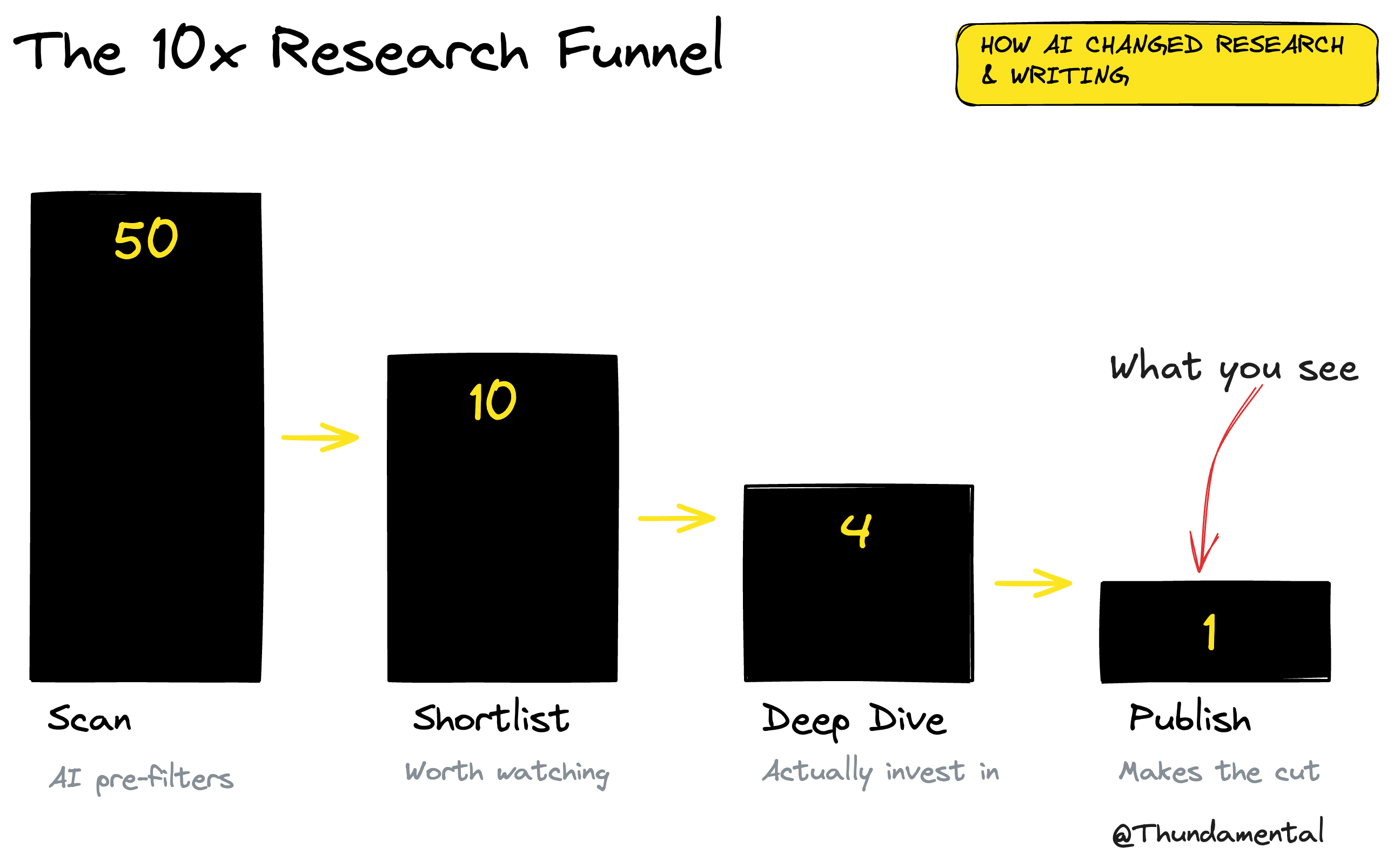
Now, AI acts as a pre-filter. Scan fifty videos and narrow it down to ten worth watching. From those ten, choose the four worth investing deeply. I still need to learn the material deeply, apply it , and figure out how it translates to my clients' world. But the funnel getting me there is ten times wider and ten times faster.
The Luxury of Discarding
For every framework published, there are twenty that didn't make it. For every article you've read, there are twenty that never saw the light of day. That was not a luxury available before AI. You had to commit early and live with it. Now it's possible to test five angles before writing a single word.
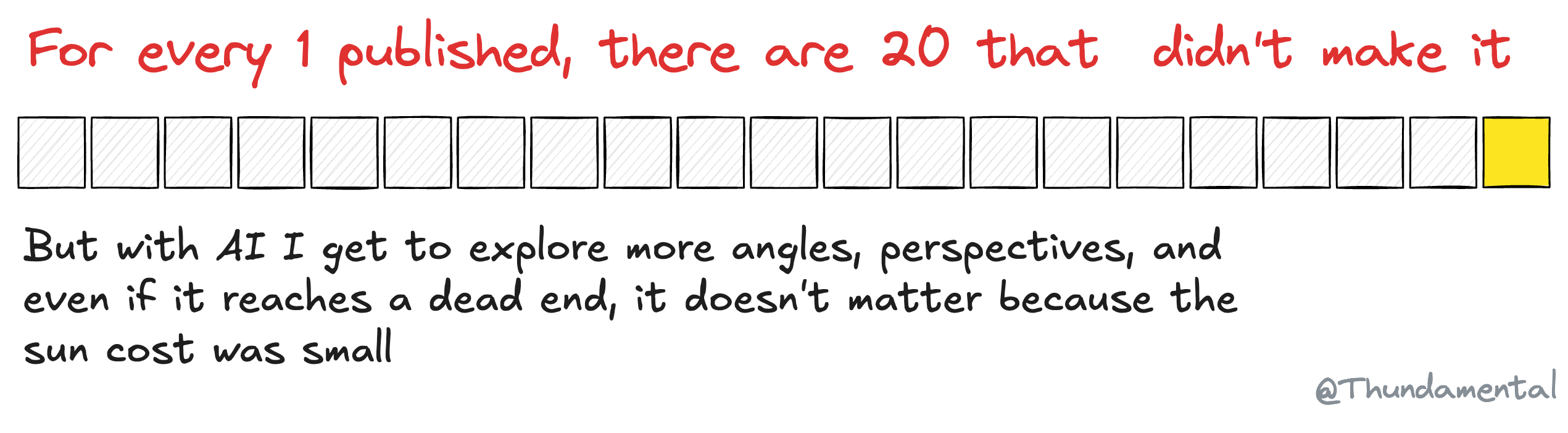
I can customise exercises for different clients instead of giving everyone the same thing. The aha moments actually land, because there was space to find them.

The Pilot Methodology
My role has shifted from "content creator" to "pilot." Not in the Microsoft Copilot sense. In the aviation sense. I fly the plane. AI is my co-pilot.
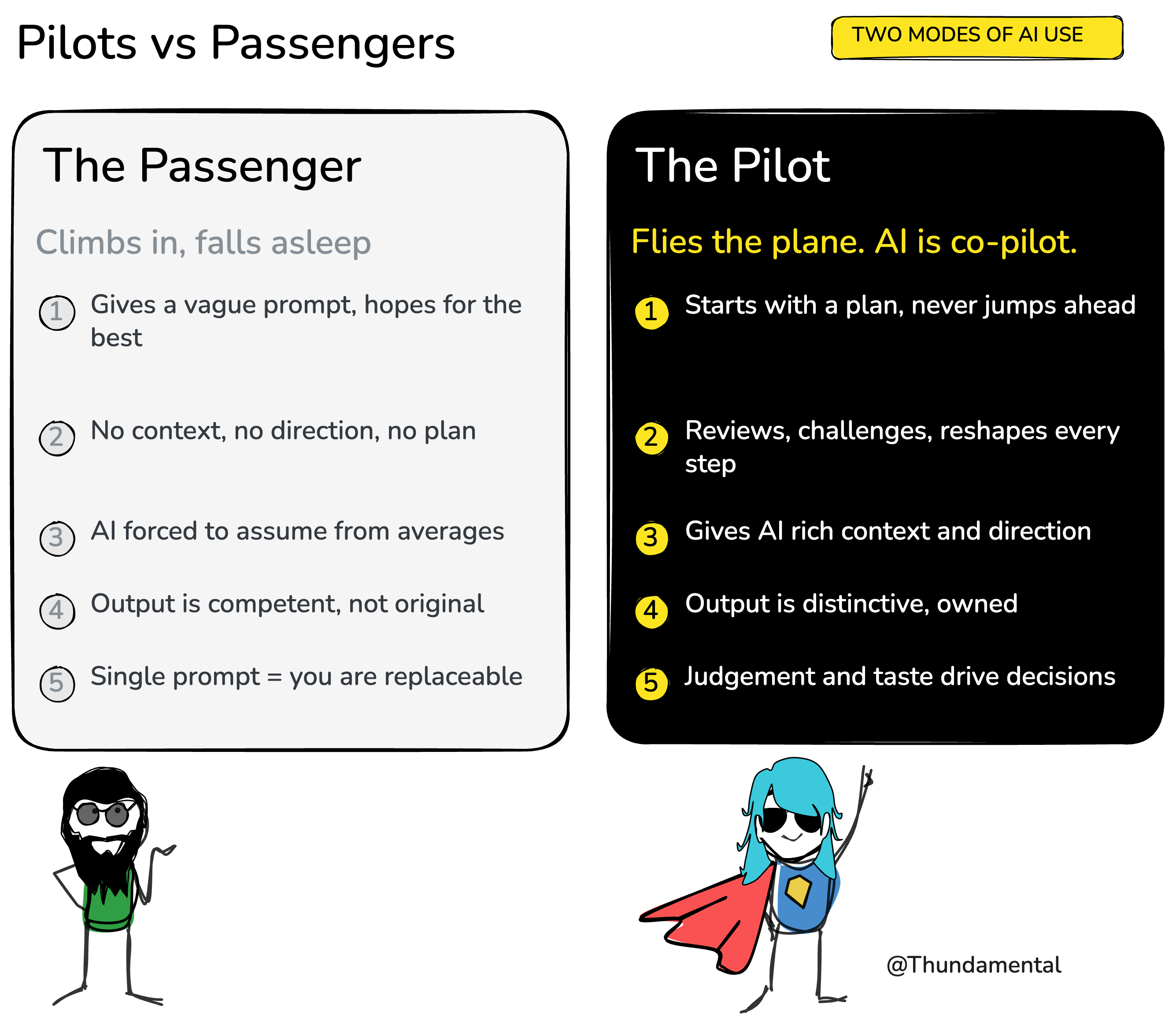
The default is the opposite. They climb in, mumble something about wanting to go somewhere nice, and fall asleep. If AI doesn't receive information or the right context, it's forced to make assumptions based on its training data, which is essentially an average. The most likely next word. Competent enough, but not original, not creative, not you.
My Process
My process might seem like it slows things down, but AI is eager. It wants to go. Give it a vague prompt and before you know it, it's built you a website and three slide decks. That sounds impressive until you realise none of it is quite what you wanted, and now you're either starting over or, worse, you keep it because it looks pretty, even though it's not right.
My pilot approach stops AI before it builds anything. Always start with a plan. "Let's plan first. Don't build yet."
Then review the plan, challenge it, reshape it, approve it.
"Okay, let's start with step one." Do step one. Give feedback. Look at every single part without getting distracted by the prettiness of something or a cool new idea. Only once satisfied, move to step two. Then step three. Each piece gets full attention before moving on.
Why Step-by-Step Wins
The one-shot approach feels efficient. You throw a prompt at AI, it builds something, and within minutes you have what looks like a finished product. But what you actually have is something that's 70% right and 30% wrong.
Now you're spending hours trying to fix that 30%, negotiate with the AI about what you actually wanted, or worse, just accepting it because the sunk cost feels too high to start again.
and now you're spending hours trying to fix that 30%, negotiate with the AI about what you actually wanted, or worse, just accepting it because the sunk cost feels too high to start again.

When all you do is write a vague prompt and press ENTER, anyone can do your job with AI… you become obsolete.
If your entire contribution is a single prompt, you're replaceable… and the output proves it.
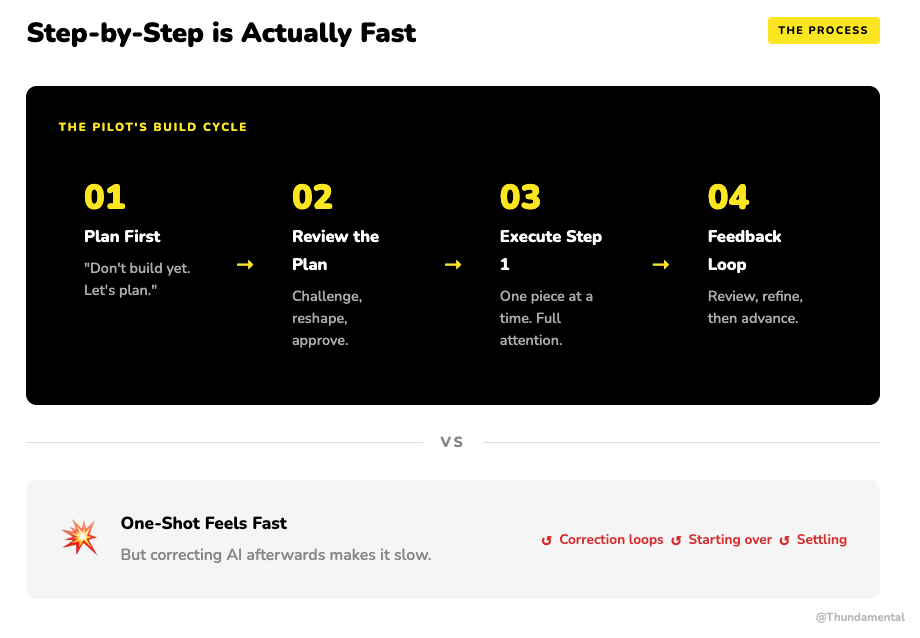
The step-by-step approach seems slower. Planning before building, reviewing before advancing, giving feedback at every stage. But because each piece is right before you move on, the total time is shorter.

There's no massive correction phase at the end. There's no "it looks great but isn't what I meant" moment.
The key insight is knowing when to pilot and when to automate. If it shapes what the business is, the pilot seat is non-negotiable. Brand identity, client work, strategic content, core methodology. Everything else? Autopilot is fine. Admin, formatting, scheduling, repetitive processes.
The mistake is treating everything like it needs piloting, or treating nothing like it does. My rule is:

Create your own pilot list:

So that's the upside. Here's the part where I admit the downside.
The AI Trap
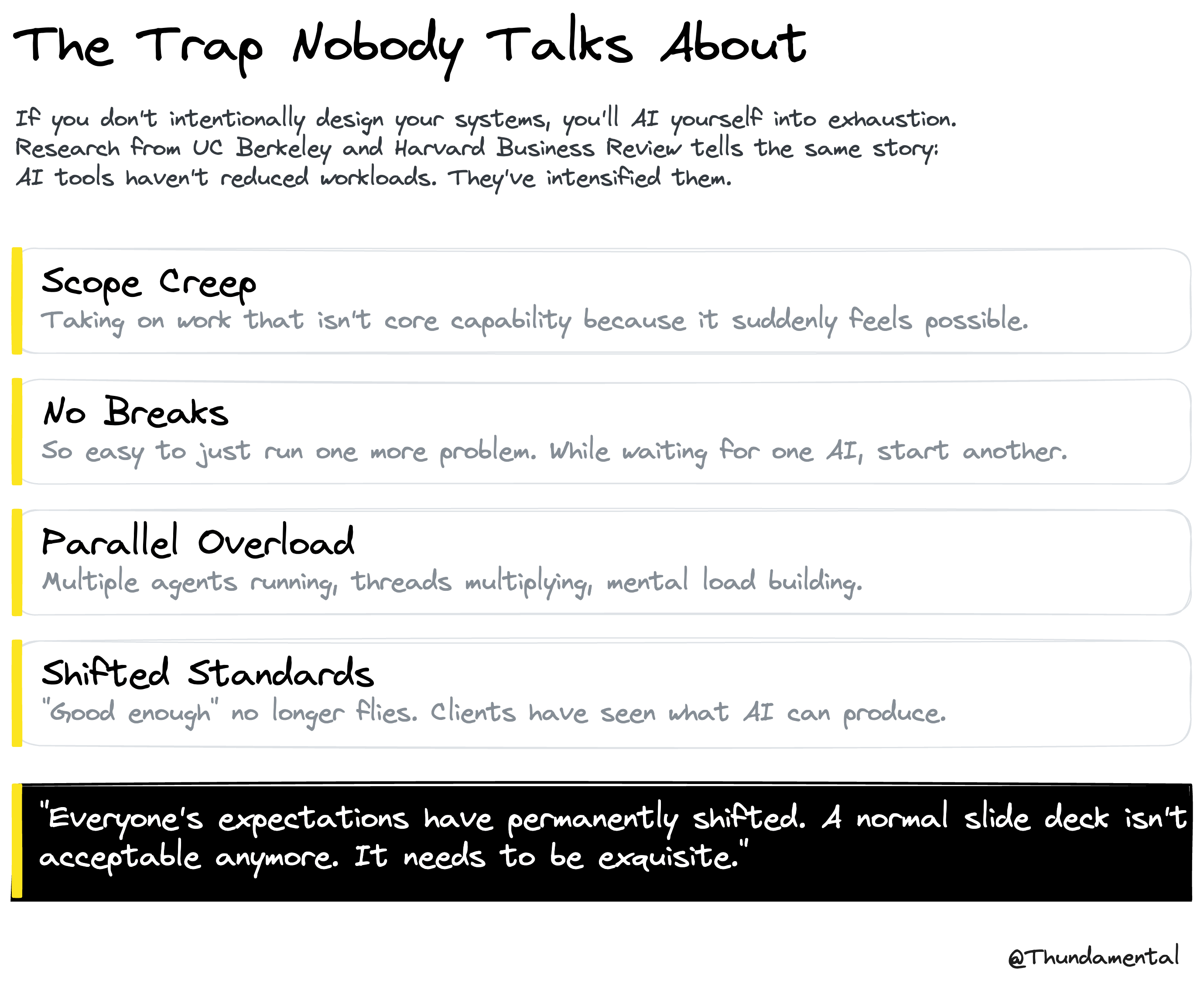
If you don't intentionally design your systems, you'll AI yourself into exhaustion.
Research from Harvard Business Review tells the same story: AI tools haven't reduced workloads. They've intensified them.
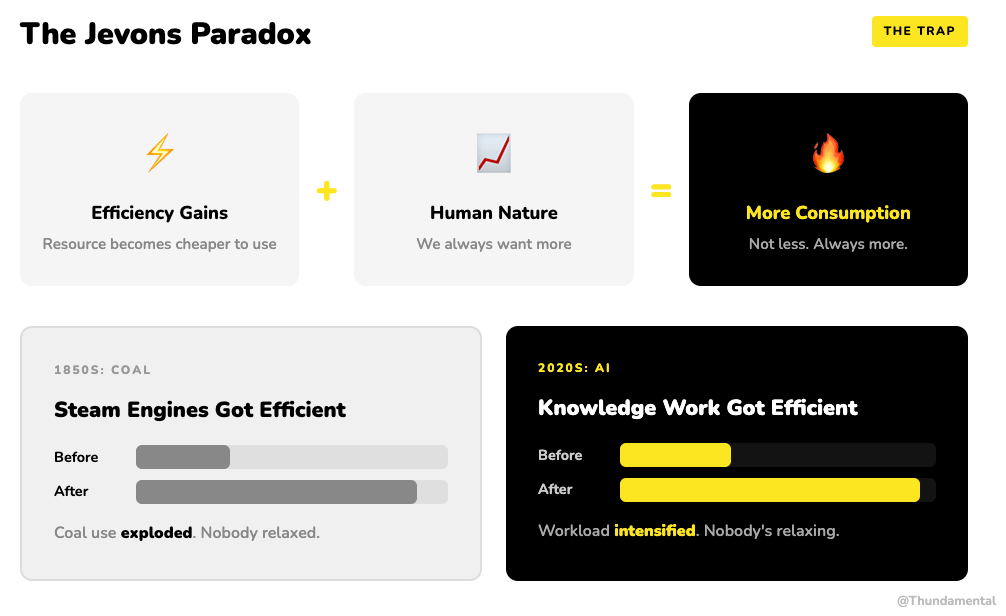
This is the Jevon’s Paradox in action. When a resource becomes more efficient, we don't use less of it. We use more. Coal-powered engines didn't reduce coal consumption. They exploded it. Nobody in 1850 looked at a steam engine and thought "great, now I can finally relax." AI-powered work follows the same logic.
My Personal Reality
AI hasn't meant less work. If anything, it's meant more. Taking on work that isn't core capability because suddenly it feels possible. Migrating email providers in a morning. (using AI, screenshots of what to do next). In the past, I would have just left that.
Designing, writing, building solutions, exploring frameworks that would never have been touched before. Work that would previously have been handed off or ignored entirely now lands on the desk because AI made it feel doable.
Breaks don't happen because it's so easy to just run one more problem
While waiting for one AI to finish, another task starts, then another
Multiple agents run in parallel, threads multiply, mental load builds
Expectations have permanently shifted: "good enough" no longer flies

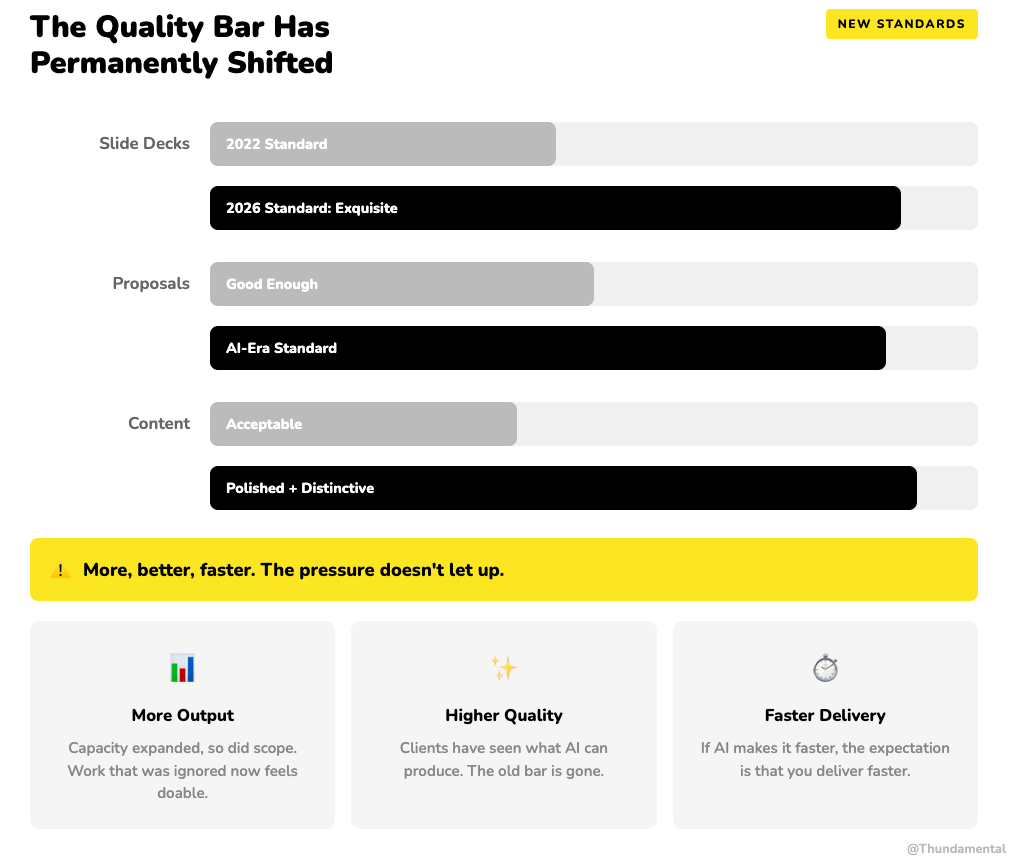
A normal slide deck isn't acceptable anymore, it needs to be exquisite. A good-enough proposal doesn't fly when your client has seen what AI can produce. The standards of two years ago are completely blown out of the water. It's not just that we can do more. It's that we're expected to. More, better, faster: and that pressure doesn't let up.
The Real Lesson: Systems, Not Speed
The upside is real. The exploration, the speed, the quality. All of it. But so is the trap. If you don't intentionally design how you spend that capacity, you'll just run faster on a treadmill that someone else keeps speeding up.
That's why my thinking shifted to systems. Not just how to use AI, but how everything in my business fits together. How knowledge flows from research to content to client delivery. How to capture work so it compounds instead of evaporating. How to make sure yesterday's effort is doing half of today's job for me (based on Kieran Klaasen’s concept of Compound Engineering).
The Three Questions
How does knowledge flow? From research to content to client delivery, every insight should have a clear path through the system
How does work compound? Every framework, every template, every process should make the next one easier to build
How does yesterday help today? If each day starts from zero, the AI advantage is wasted on a treadmill
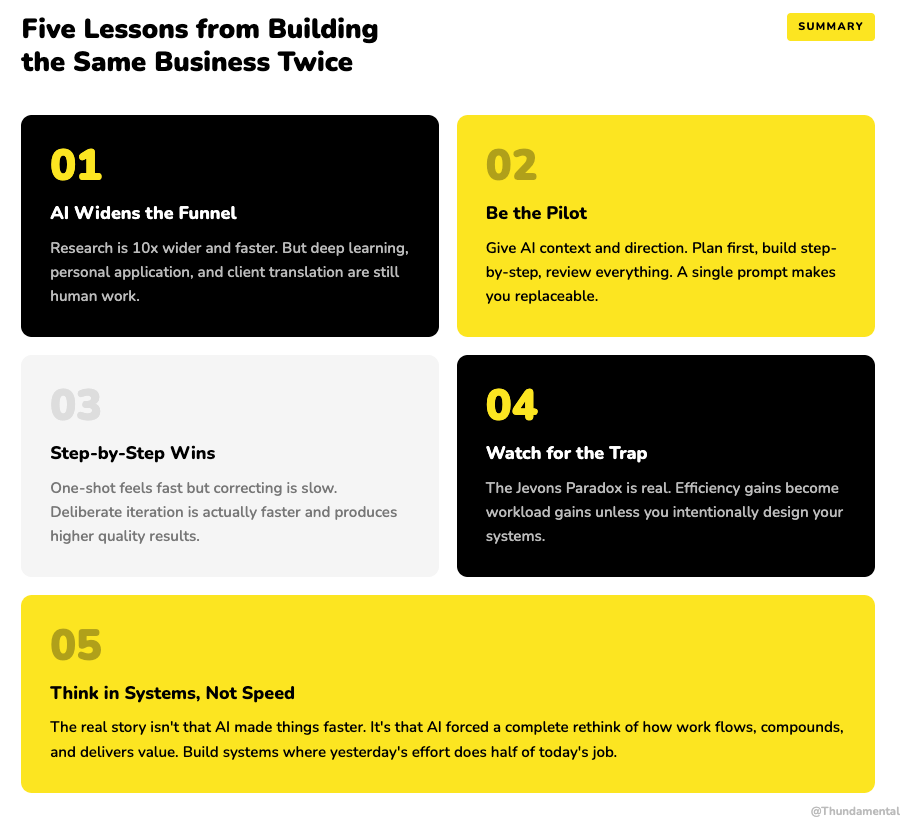
The lesson’s are real, and have changed the way I work forever.
Want to explore how to bring AI into your organisation?
The question is: are you brave enough to try an approach that looks slower on paper but delivers exponentially better results in practice?
👉 Schedule a free consultation and let’s get started.
If you forget everything else, remember this…
AI let me rebuild the business I love, where yesterday's effort does half of today's job.
Don’t want to miss our next newsletter? | Or, if you’re already a subscriber… |